
Indian Ringneck Parrot Talk: 4 Proven Steps to Train Them
Table of Contents
You brought home your Indian Ringneck three months ago. He watches you talk, tilts his head, makes sounds — but nothing that resembles a word. You start wondering: do Indian Ringnecks actually talk, or is that just something people say?
Here’s the honest answer: Indian Ringneck parrots are among the best talking birds you can own. But there’s a catch — they talk on their own timeline, and most owners make training mistakes that delay progress by months.
This guide covers everything you need to know about Indian Ringneck parrot talk: when it starts, how to train it, why some birds stay silent, and what actually works.
Do Indian Ringnecks Talk? Ability and Expectations
Yes — Indian Ringneck parrots talk, and they do it well. They’re widely considered one of the top five talking parrot species in the world, alongside African Greys, Amazon Parrots, and Eclectus.
What makes them stand out isn’t just that they can mimic words. It’s that they speak with unusual clarity. Unlike some parrots that produce muffled approximations, Indian Ringnecks often produce words that are immediately recognizable — even to people who’ve never heard a talking bird before.
A well-trained Indian Ringneck can typically learn between 200 and 400 words. Some individuals go beyond that. Their voices tend to be slightly high-pitched but clear, and many owners report that their birds use words in context — not just repeating them randomly.
That said, talking ability varies significantly between individuals. Genetics, environment, socialization, and training consistency all play a role. Not every Indian Ringneck will become a talker, but the majority will — if you put in the work early.
At What Age Do Indian Ringnecks Start Talking?
This is the question most new owners obsess over — and the source of a lot of unnecessary frustration.
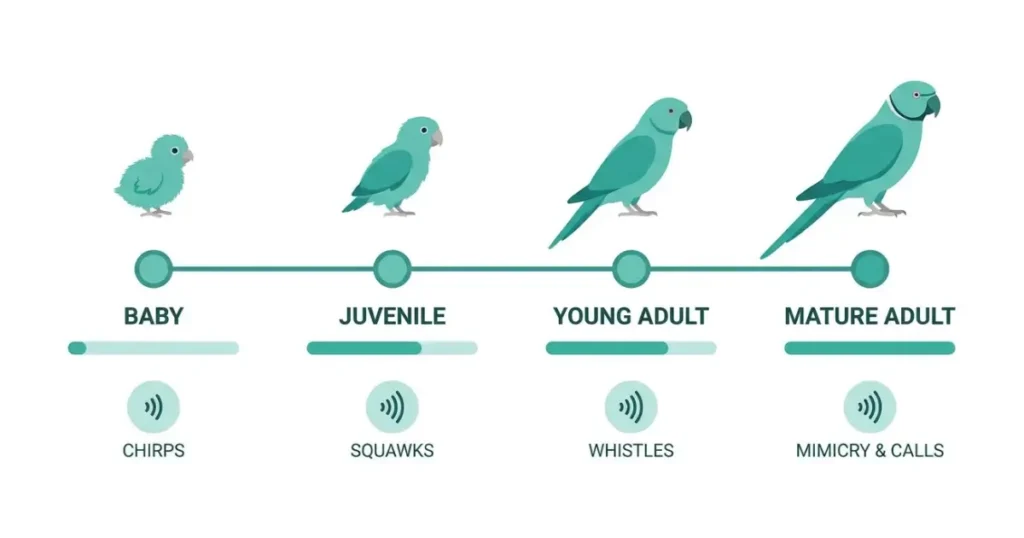
Indian Ringnecks typically start talking between 8 months and 1 year of age. Some start as early as 6 months. Others don’t produce their first clear word until 14 or 15 months.
The “bluffing stage” — a hormonal phase that usually hits between 4 and 12 months — often delays visible progress. Your bird may seem less responsive, more nippy, and less interested in interaction during this period. This is normal. Keep training consistently through it.
What affects when talking starts:
- Birds hand-raised from a young age tend to talk earlier
- Males generally start talking sooner than females
- Birds that hear a lot of consistent human speech develop faster
- Stress, illness, or a recent change in environment can delay onset
If your bird is under 14 months and hasn’t said a word yet, don’t panic. Keep going.
How to Train an Indian Ringneck to Talk
Training an Indian Ringneck to talk isn’t complicated, but it requires consistency. Most owners who fail do so not because of technique — but because they’re inconsistent or start training before building trust.
Step 1 — Build Trust First
This is non-negotiable. An Indian Ringneck that doesn’t trust you will not talk to you. Period.
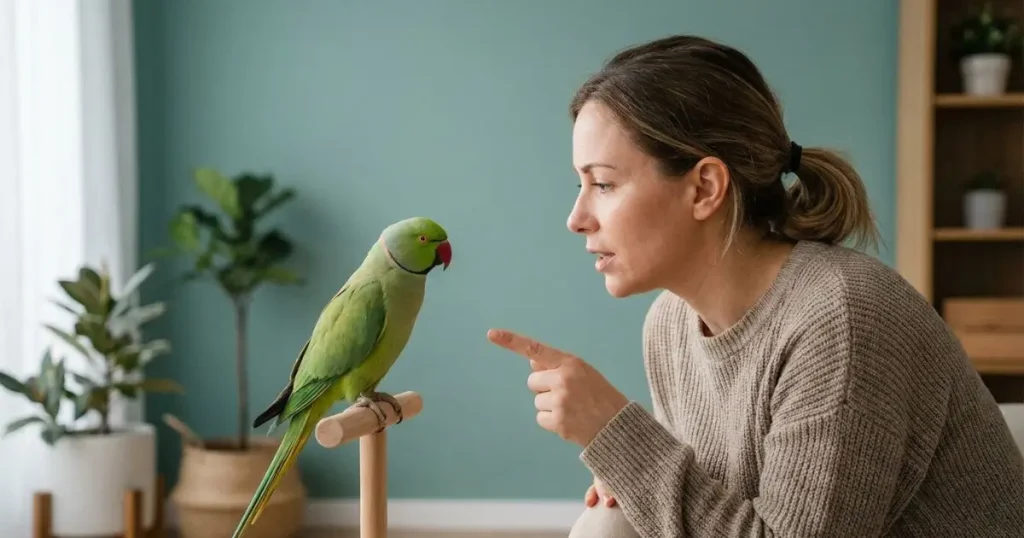
Spend the first 4 to 8 weeks focused entirely on bonding — not training. Sit near the cage, talk softly, offer treats by hand, let the bird approach you on its own terms. Ringnecks are proud birds. They respond to patience, not pressure.
You’ll know trust is established when your bird actively seeks your attention, steps up without resistance, and vocalizes when you enter the room.
Step 2 — Start With Simple, Clear Words
Once trust is established, choose 2 to 3 short words to begin with. The best starter words for Indian Ringnecks are:
- Their own name
- “Hello” or “Hi”
- “Step up”
- Your name
Avoid starting with phrases or sentences. One clear word repeated consistently is more effective than ten words repeated occasionally.
Speak directly to your bird, at eye level, with clear enunciation. Repeat the word 10 to 15 times per session. Keep sessions short — 5 to 10 minutes, two to three times per day.
Step 3 — Use Positive Reinforcement
When your bird makes any sound that resembles the target word — even vaguely — respond with immediate positive reinforcement. Excitement in your voice, a favorite treat, or enthusiastic interaction all work.
Never punish silence or incorrect sounds. Indian Ringnecks are sensitive to negative reactions and will shut down if training feels stressful.
Step 4 — Be Consistent With Sessions
The single biggest predictor of talking success is consistency. Daily 5-minute sessions beat weekly 30-minute sessions every time.
Create a routine — same time of day, same location, same energy. Ringnecks are pattern-oriented birds. They learn faster when sessions feel predictable.
What Words Do Indian Ringnecks Learn Fastest?
Indian Ringnecks learn words that are emotionally significant in their environment fastest. This means words they hear repeatedly in the context of excitement, food, or interaction.
Words and phrases they pick up quickly:
- Their name (especially if used every time you interact)
- Greetings — “Hello”, “Hi”, “Good morning”
- Food words — “banana”, “treat”, “hungry”
- Action words tied to routine — “step up”, “come here”, “good bird”
- Words spoken with high emotional energy — laughter, excitement
They also tend to mimic sounds before words — phone ringtones, microwave beeps, other birds. This is a good sign. It means the vocal learning process is active.
Why Your Indian Ringneck Is Not Talking Yet
If your bird is past 14 months and still silent, here are the most common reasons:
| Reason | Fix |
| Under 14 months | Be patient — keep daily sessions |
| Not enough trust | Go back to bonding before training |
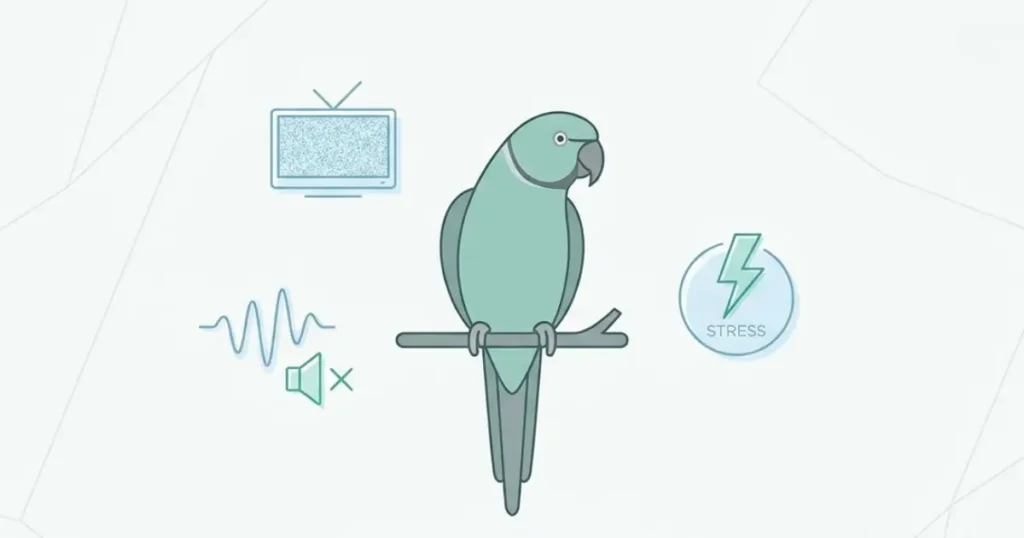
| Too much background noise | Train in a quiet room |
| Inconsistent training | 5 min daily beats 1 hour weekly |
| Bluffing stage (4-12 months) | Normal — push through it |
| Health or stress issue | Vet check recommended |
Not enough one-on-one interaction — Indian Ringnecks learn to talk to connect with the people they’re bonded to. If your bird spends most of its time alone or in a high-traffic area with background noise, talking is less likely to develop.
Too much background noise — TVs, radios, and other birds compete with your training. Ringnecks learn best in a quieter environment where your voice is the dominant sound.
Still in the bluffing stage — if your bird is between 4 and 12 months, the bluffing phase may be suppressing progress. It will pass.
Not enough repetition — occasional training doesn’t work. Five consistent minutes every day will outperform an hour once a week.
Stress or health issue — a bird that’s unwell, stressed by a recent move, or uncomfortable in its environment won’t focus on talking. Rule out health issues with a vet check if you’re concerned.
Wrong approach to trust — if your bird is still skittish around you, talking training won’t work. Go back to trust-building before resuming word training.
Stress and environmental factors play a significant role in vocal development. The World Parrot Trust recommends ensuring a stable, low-stress environment as a foundation for any parrot training program.
Do Female Indian Ringnecks Talk?
Yes — but with a caveat.
Female Indian Ringnecks can absolutely learn to talk, and some females develop impressive vocabularies. However, on average, males tend to start talking earlier and develop larger vocabularies than females.
This is not a hard rule. Individual variation matters more than gender. A well-socialized, consistently trained female will outperform a neglected male every time.
If you have a female Ringneck, apply the same training approach. Don’t lower your expectations — just be patient.
Tips to Improve Your Indian Ringneck’s Talking Skills
Once your bird has started talking, these habits will accelerate vocabulary growth:
Talk to your bird constantly — narrate what you’re doing. “I’m making coffee.” “Time for your food.” Your bird is always listening, even when it doesn’t seem like it.
Use words in context consistently — say “hello” every time you enter the room. Say their name every time you offer a treat. Contextual repetition is how birds build meaning around words.
Mirror sessions — some owners find that training in front of a mirror works well for Indian Ringnecks. The visual stimulus increases engagement.
Record yourself — play a short recording of yourself repeating target words when you’re not home. Keep it brief — 10 to 15 minutes. Overuse of recordings can backfire and create mechanical repetition without understanding.
Celebrate every attempt — even a muffled approximation of the target word deserves a reaction. Enthusiasm accelerates learning.
Is an Indian Ringneck Right for You?
Indian Ringneck parrots are rewarding, intelligent, and genuinely impressive talkers. But they’re also independent, can be nippy during their bluffing stage, and need daily interaction to thrive.
Before committing to one, make sure your lifestyle matches what this bird needs.
Not sure if an Indian Ringneck fits your lifestyle? Take our free Pet Matchmaker — answer a few questions about your home, schedule, and experience, and we’ll match you with the bird species that suits you best.
Frequently Asked Questions
How long does it take an Indian Ringneck to start talking?
Most Indian Ringnecks produce their first recognizable word between 8 and 14 months of age. Training consistency, trust, and individual genetics all affect timing. If your bird is under 14 months and hasn’t talked yet, continue daily sessions — it’s rarely a sign of a problem.
Can all Indian Ringnecks learn to talk?
Most can, but not all will. Talking ability varies by individual, not just species. Birds that are hand-raised, well-socialized, and consistently trained have the highest chance of developing speech. Some birds simply have less vocal inclination regardless of training.
At what age should I start training my Indian Ringneck to talk?
Start building trust from day one, but wait until your bird is comfortable being handled before introducing word training — usually around 3 to 4 months for hand-raised birds. Starting too early before trust is established often backfires.
Do Indian Ringnecks talk as well as African Greys?
African Greys are generally considered the gold standard for talking parrots, with deeper contextual understanding. Indian Ringnecks are close behind in clarity and vocabulary size, but tend to be less contextually sophisticated. For most owners, Indian Ringneck talking ability is more than impressive.
Final Thoughts on Indian Ringneck Parrot Talk
Indian Ringneck parrots are genuine talkers — not just mimics. With the right approach, most will develop a clear, recognizable vocabulary that will surprise everyone who hears them.
The formula isn’t complicated: build trust first, train consistently with short daily sessions, use positive reinforcement, and be patient through the bluffing stage. The owners who give up at month three are the ones who never get to hear their bird say their name.
Start with one word. Repeat it every day. The rest follows.