
Betta Fish Tank Setup: Size, Filter & Everything You Need to Know
Table of Contents
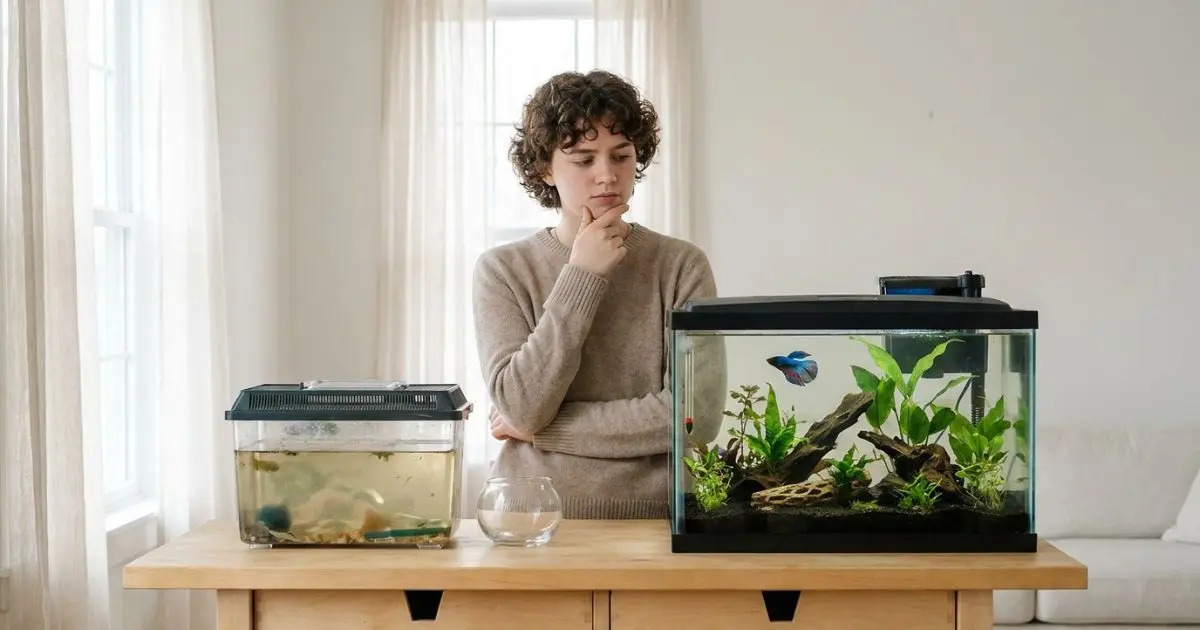
You just bought a betta fish. The pet store told you a small bowl would be fine. You get home, set it up, and two weeks later your betta is lethargic, faded, and barely moving.
This is the most common betta fish story — and it’s almost always a tank problem.
Setting up a betta fish tank correctly isn’t complicated, but there’s a lot of bad advice out there. This guide covers everything you actually need: the right size, filtration, temperature, tank mates, and how to keep it clean — so your betta lives a long, healthy life instead of just surviving.
How Big Should a Betta Fish Tank Be?
This is where most new betta owners get it wrong — and where the pet store often doesn’t help.
Minimum Tank Size — Quick Answer
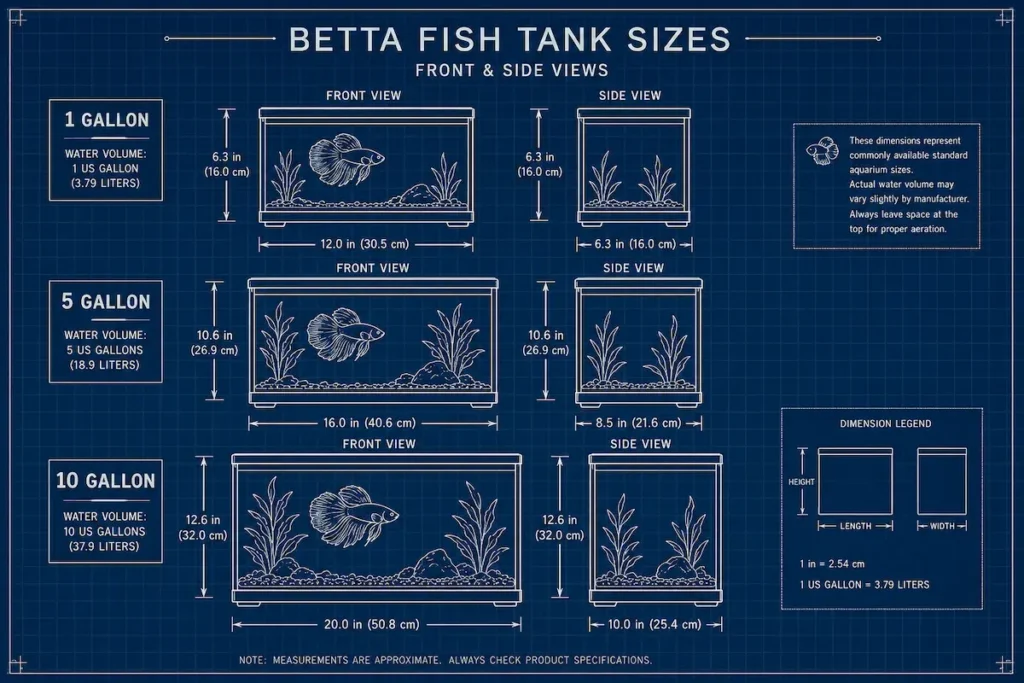
The absolute minimum for a betta fish is 5 gallons. Anything smaller creates water quality problems that are nearly impossible to manage, even with frequent water changes. According to The Spruce Pets, tanks under 5 gallons cause ammonia and nitrite spikes that stress and ultimately kill betta fish — even when they appear fine on the surface.
A 1-gallon bowl or 2.5-gallon tank might look cute, but it’s not a viable habitat for a healthy betta.
Ideal Tank Size — Why Bigger Is Better
The ideal betta fish tank size is 10 gallons. Here’s why:
- Water stability — larger volumes dilute waste more effectively, making the water safer between changes
- Temperature stability — small tanks heat and cool rapidly, stressing the fish
- Swimming space — bettas are active fish that explore their environment. A 10-gallon tank gives them room to behave naturally
- Easier maintenance — counterintuitively, bigger tanks are easier to maintain because the water parameters stay stable longer
If 10 gallons isn’t possible for your space or budget, a 5-gallon tank is acceptable — but commit to more frequent water changes.
5 Gallon vs 10 Gallon — Which Is Better?
Here’s a simple visual comparison to help you understand the difference between common betta fish tank sizes.
| 5 Gallon | 10 Gallon | |
|---|---|---|
| Minimum viable | ✅ Yes | ✅ Yes |
| Water stability | Moderate | High |
| Maintenance frequency | Weekly | Every 2 weeks |
| Room for tank mates | No | Limited |
| Cost | Lower | Moderate |
| Recommended for beginners | ✅ Acceptable | ✅ Best choice |
If you’re a first-time betta owner, go with 10 gallons. You’ll spend less time managing water problems and more time enjoying your fish.
What Is a Healthy Betta Fish Tank Environment?
Before getting into equipment, it helps to understand what betta fish actually need — because this shapes every decision you make about their setup.
Betta fish are native to the shallow, warm waters of Southeast Asia — rice paddies, slow streams, and ponds. Their natural environment is:
- Warm — 76°F to 82°F (24°C to 28°C)
- Slow-moving — bettas struggle in strong currents
- Heavily planted — they use plants and structures to rest and hide
- Slightly acidic — pH between 6.5 and 7.5
Every equipment choice you make — filter, heater, plants, decorations — should recreate these conditions as closely as possible.
Do Betta Fish Need a Filtered Tank?
Yes — always. This is non-negotiable.
The myth that bettas don’t need filters comes from the fact that they can breathe atmospheric air using a specialized organ called the labyrinth. But breathing air doesn’t mean they can survive in toxic water.
Without filtration, ammonia from fish waste builds up rapidly. Ammonia burns a fish’s gills, fins, and skin — causing fin rot, disease, and death. You can do daily water changes to compensate, but no beginner actually maintains that schedule consistently.
Why Filtration Matters
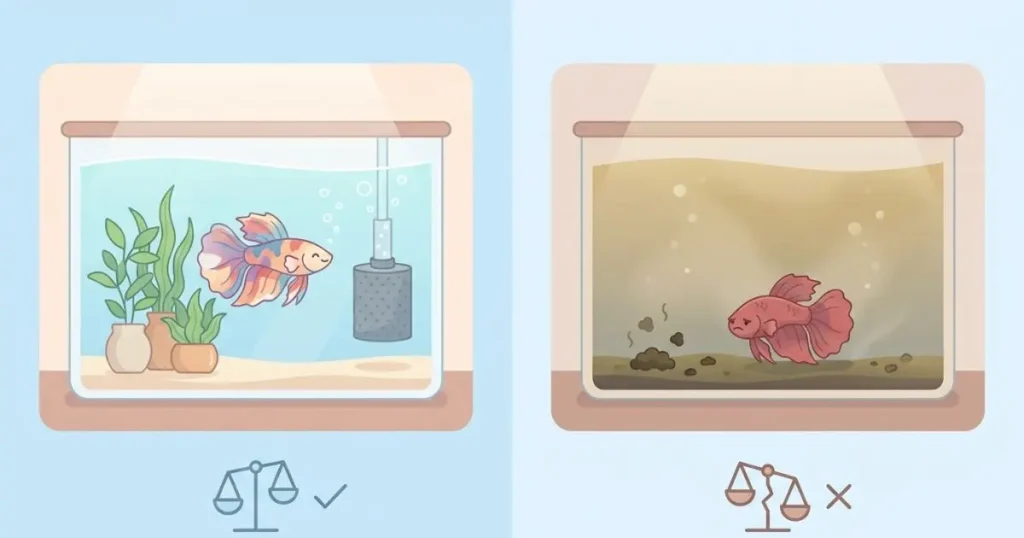
A filter does three things:
- Mechanical filtration — removes physical waste particles from the water
- Biological filtration — grows beneficial bacteria that convert toxic ammonia into less harmful nitrates
- Chemical filtration — removes dissolved impurities and odors
The biological filtration is the most critical. It takes 4 to 6 weeks to fully establish in a new tank — a process called “cycling.” Skipping this step is the number one reason new betta fish die in the first month.
Best Filter Types for Betta Tanks
Bettas need low-flow filtration. Strong currents exhaust them and damage their fins.
| Filter Type | Best For | Notes |
|---|---|---|
| Sponge filter | 5-10 gallon tanks | Gentle flow, beginner-friendly |
| Hang-on-back (HOB) | 10+ gallon tanks | Adjust flow rate to lowest setting |
| Canister filter | Larger setups | Overkill for most betta tanks |
| Internal filter | Small tanks | Works but can be hard to adjust |
Recommendation for beginners: A sponge filter for a 5-gallon tank or a low-flow HOB filter for a 10-gallon tank. According to Aquarium Co-Op, sponge filters are among the most reliable and gentle options for betta fish specifically.
Betta Fish Tank Temperature and Water Requirements
Bettas are tropical fish. They cannot regulate their own body temperature — which means your tank water temperature directly controls their metabolism, immune system, and behavior.
Required temperature range: 76°F to 82°F (24°C to 28°C)
At temperatures below 74°F, bettas become lethargic, stop eating, and become vulnerable to disease. At temperatures above 84°F, oxygen levels in the water drop and stress increases.
You need a heater. Room temperature is almost never stable enough — and “room temperature” in most US homes hovers around 68-72°F in winter, which is too cold for a betta.
Water parameters to maintain:
| Parameter | Target Range |
|---|---|
| Temperature | 76°F – 82°F |
| pH | 6.5 – 7.5 |
| Ammonia | 0 ppm |
| Nitrite | 0 ppm |
| Nitrate | Under 20 ppm |
| Hardness (GH) | 3–4 dGH |
Test your water weekly for the first two months. A basic liquid test kit is more accurate than test strips and costs around $25.
What Can Live With a Betta Fish?
Bettas are territorial — especially males. A male betta will attack any fish it perceives as a rival, and will almost always attack another male betta on sight.
That said, a 10-gallon tank can support some compatible tank mates.
Compatible Tank Mates
- Corydoras catfish — peaceful bottom dwellers, stay out of the betta’s territory
- Nerite snails — great for algae control, ignored by most bettas
- Ghost shrimp — work in some setups, but some bettas will hunt them
- Harlequin rasboras — fast, peaceful, tend to avoid bettas
- African dwarf frogs — generally compatible in larger tanks
What to Avoid
- Other male bettas — always a problem
- Fin-nipping fish (tiger barbs, serpae tetras) — will destroy a betta’s fins
- Brightly colored fish — may trigger aggression
- Female bettas — can coexist in sorority tanks of 4+ females with 20+ gallons, not recommended for beginners
Betta fish are territorial by nature — which explains both their tank mate requirements and behaviors like flaring. If your betta flares frequently, it’s worth understanding why. Read our full guide on Why Is My Betta Fish Flaring? 5 Real Reasons & What to Do for a complete breakdown.
How to Set Up a Betta Fish Tank — Step by Step
Setting up correctly from the start prevents 90% of common betta problems.
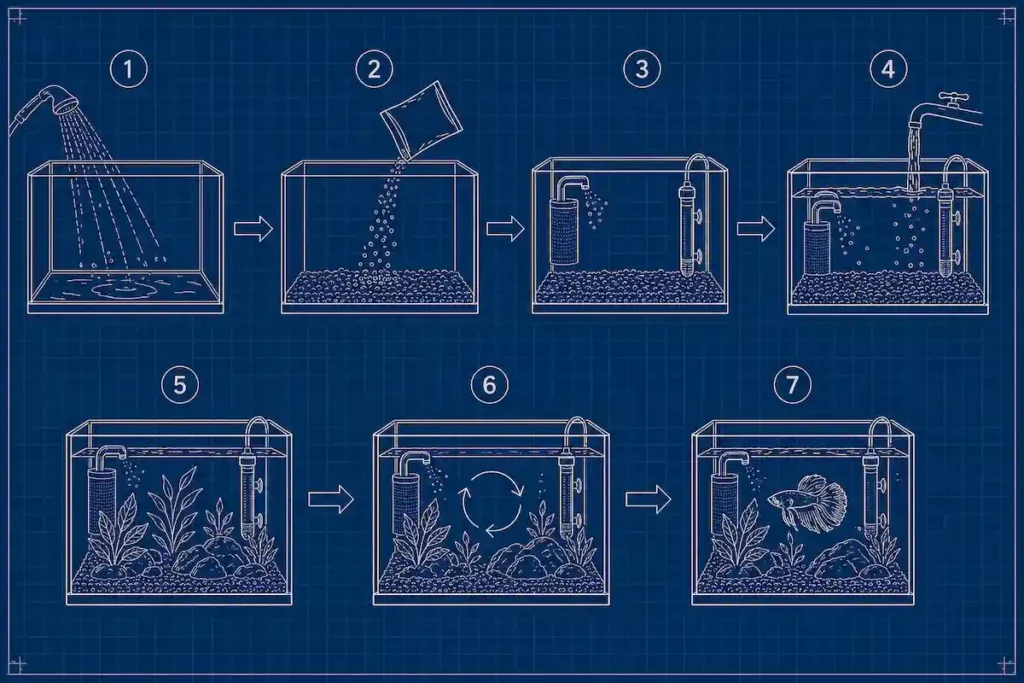
Step 1 — Rinse everything Rinse the tank, gravel, and decorations with plain water. No soap, no cleaning products — ever.
Step 2 — Add substrate 1 to 2 inches of fine gravel or sand. Bettas appreciate darker substrates that don’t reflect light aggressively.
Step 3 — Install filter and heater Position the filter to create gentle circulation without a direct current. Set the heater to 78°F.
Step 4 — Fill with dechlorinated water Use a water conditioner like Seachem Prime to neutralize chlorine and chloramine from tap water before adding it to the tank.
Step 5 — Add plants and decorations Live plants are ideal — Java fern, Anubias, and Amazon sword are hardy and don’t require special lighting. If using artificial plants, choose silk over plastic to protect fins.
Step 6 — Cycle the tank Run the filter for 4 to 6 weeks before adding your betta. Add a source of ammonia (pure ammonia drops or fish food) to feed the bacterial colony as it establishes. Test water parameters weekly until ammonia and nitrite both read 0 ppm.
Step 7 — Add your betta Float the bag in the tank for 15 minutes to equalize temperature, then slowly mix small amounts of tank water into the bag over 30 minutes before releasing the fish.
Not sure which specific products are right for your betta’s setup? Use our free Pet Product Finder to get personalized recommendations based on your tank size and experience level.
How to Clean a Betta Fish Tank
Regular maintenance keeps water parameters stable and your betta healthy. The schedule depends on your tank size.
For a 5-gallon tank:
- 25-30% water change every week
- Gravel vacuum during each water change
- Rinse filter media in old tank water (never tap water) monthly
For a 10-gallon tank:
- 25% water change every 2 weeks
- Gravel vacuum during water changes
- Check filter media monthly
Critical rule: Never do a 100% water change. It destroys the beneficial bacteria colony in your filter and resets the nitrogen cycle — effectively crashing your tank. Always leave at least 75% of the existing water in place.
Always treat new water with a dechlorinator before adding it to the tank. Chlorine kills beneficial bacteria as effectively as it kills harmful bacteria.
Frequently Asked Questions
How big should a betta fish tank be?
The minimum is 5 gallons — anything smaller creates unstable water conditions that stress and eventually kill betta fish. The ideal size for most owners is 10 gallons, which provides better water stability, easier maintenance, and more space for the fish to behave naturally.
Can a betta fish live in a 1-gallon tank?
Technically they can survive short-term, but they won’t thrive. A 1-gallon tank cannot support a filter effectively, temperature swings are severe, and ammonia builds up within hours. It’s not a humane long-term habitat for a betta fish.
Do betta fish need a heater?
Yes — always. Bettas require water temperatures between 76°F and 82°F. Room temperature in most homes is too cold, especially in winter. A stable temperature is one of the most important factors in a betta’s immune health and lifespan.
How often should I clean my betta fish tank?
For a 5-gallon tank, a 25-30% water change weekly. For a 10-gallon tank, every two weeks. Always use a gravel vacuum and treat new water with dechlorinator before adding it. Never do a complete water change.
Final Thoughts on Betta Fish Tank Setup
Getting the tank right is the most important thing you can do for your betta fish — more than food, more than decorations, more than anything else. The fish you see at the pet store surviving in a small cup is not a fish that’s thriving. It’s a fish waiting for a proper home.
Start with at least 5 gallons, add a gentle filter, install a heater, cycle the tank before adding your fish, and maintain a consistent water change schedule. Follow those steps and your betta will be a completely different animal — active, colorful, and full of personality.
Ready to find the right products for your betta’s setup? Use our Pet Product Finder to get recommendations tailored to your tank size and budget.
This article is for informational purposes only and is based on general care guidelines for betta fish. Individual fish may have different needs. Always consult an aquatic specialist or veterinarian if your betta shows signs of illness or distress.